ISP / Enterprise / Cloud Network Architecture
This project simulates a complete multi-AS network architecture involving:
- an Enterprise Network (Admin, Dev, Marketing)
- an ISP Backbone (AS5)
- a Cloud Provider network (AS567)
- a Personal / Remote network
- dynamic routing (OSPF + BGP)
- redundancy (HSRP, dual uplinks)
- tunnels & NAT
- multi-tier LAN design (access / distribution / core)
It was built and validated entirely in GNS3.
🖥️ Network Topology
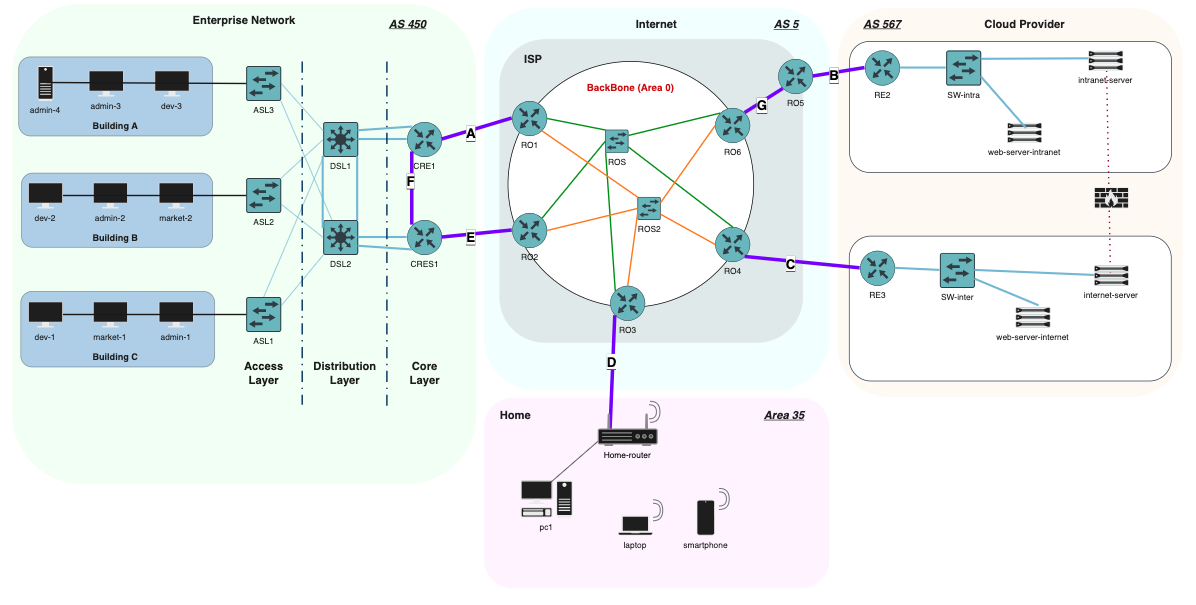
📘 Network Addressing Summary
| Category | Element / Link | Subnet / IP | Notes |
|---|---|---|---|
| Enterprise Network (AS450) | Administrators VLAN | 192.168.10.0/24 |
VLAN 10 |
| Developers VLAN | 192.168.20.0/24 |
VLAN 20 | |
| Marketing VLAN | 192.168.30.0/24 |
VLAN 30 | |
| Maintenance VLAN | 192.168.99.0/28 |
VLAN 99 | |
| Public IP | 223.1.2.136/29 |
Enterprise external range | |
| Operator Backbone (AS5) | ROS1 Backbone | 12.0.0.0/29 |
Area 0 |
| ROS2 Backbone | 12.0.10.0/29 |
Area 0 | |
| Personal Network (Area 35) | Personal Subnet | 192.168.47.0/28 |
Home LAN |
| Gateway | 192.168.47.1 |
Home router | |
| Public IP | 12.1.2.3 |
User external IP | |
| Cloud Provider (AS567) | Intranet Subnet | 192.168.60.0/24 |
via RE2 |
| Intranet Gateway | 192.168.60.1 |
— | |
| Intra Web Server | 192.168.60.2 |
— | |
| Intranet Server | 192.168.60.3 |
— | |
| Internet Subnet | 163.173.19.224/28 |
via RE3 | |
| Internet Gateway | 163.173.19.225 |
— | |
| Internet Web Server | 163.173.19.226 |
— | |
| Internet Intranet Server | 163.173.19.227 |
— | |
| Point-to-Point Links (A–G) | Link A | 223.1.2.128/31 |
P2P |
| Link B | 163.173.18.254/31 |
P2P | |
| Link C | 163.173.19.222/31 |
P2P | |
| Link D | 12.1.2.2/31 |
P2P | |
| Link E | 223.1.2.130/31 |
P2P | |
| Link F | 172.12.99.0/31 |
Area 1 | |
| Link G | 13.0.0.0/31 |
Area 10 |
🎯 Objectives
The main goals of this architecture were:
1. Replace static routing with dynamic routing
- OSPF Area 0 for the ISP backbone
- iBGP + eBGP peering between ASes
- Controlled redistribution (OSPF ↔ BGP)
2. Improve interconnection between all networks
- Enterprise → ISP
- ISP → Cloud Provider
- Personal network → ISP → Cloud
3. Add redundancy & high availability
- HSRP for gateway failover
- Dual uplinks towards ISP
- Core/distribution/access architecture for LAN
4. Secure and optimize internal traffic
- VLAN segmentation
- NAT boundaries
- Private tunnels for intranet and remote access
🧩 Architecture Overview
Enterprise Network (AS450)
- 3 floors (Admin, Dev, Marketing)
- VLAN segmentation per department
- DHCP, NAT, ACLs
- Three-tier design:
- Access (ASL1/ASL2/ASL3)
- Distribution (DSL1/DSL2)
- Core (CRE1/CRES1)
- HSRP for gateway redundancy
ISP Network (AS5)
- OSPF Backbone (Area 0)
- Six core routers (RO1 → RO6)
- Dual redundant mesh
- Route redistribution to BGP
- Public IP allocation
Cloud Provider (AS567)
- Public subnet + DMZ
- Internal services (Web, Intranet)
- External services (Internet-facing servers)
- Border routers (RE2/RE3) → eBGP
Personal Network
- NAT, DHCP, client testing
- BGP/OSPF learned routes via ISP
🔀 Routing Design
OSPF
- ISP backbone runs Area 0
- Fast convergence
- Stable neighbor adjacency between all RO* routers
- LSAs reflect link failure in real time
BGP
- eBGP between:
- Enterprise ↔ ISP
- ISP ↔ Cloud Provider
- iBGP inside Cloud AS
- Path manipulation for preferred routes
- Public IP advertisements
Redistribution
- OSPF ↔ BGP carefully controlled
- Avoided loops using filtering + metric tuning
🌐 Services & Features
✔ VLANs & Inter-VLAN routing Each department has its own subnet.
✔ HSRP Provides gateway redundancy for LAN clients.
✔ NAT
- NAT overload for enterprise private addresses
- Public NAT for Cloud web services
✔ Tunnels Encrypted tunnels used for intranet access and remote work.
✔ DHCP Automatic addressing in enterprise floors.
✔ ACLs Traffic filtering between departments + WAN access.
🛠️ Testing & Validation
The following scenarios were tested:
🔹 link failure → path convergence via OSPF
🔹 BGP peer failure → fallback path
🔹 failover between HSRP primary/standby
🔹 Cloud service reachability tests
🔹 VLAN isolation & inter-VLAN routing
🔹 NAT validation (inside → outside)
🔹 tunnel connectivity checks
All tests were performed using:
- VPCS clients
- Debian VMs
- PING, TRACEROUTE, IPERF
- GNS3 packet captures
📚 What I Learned
- Designing real-world multi-AS architectures
- Understanding redistribution pitfalls
- Implementing high availability with HSRP
- Tuning BGP & OSPF for predictable failover
- VLAN design for multi-floor enterprise networks
- Cloud/ISP interconnect logic
- Managing complexity in large topologies
If you want to explore all configurations, scenarios, and diagrams:
👉 Full project root folder